Nobody dreams of growing up to become a fraction. Ask any child what they want to be and you will hear astronaut, vet, or footballer. Not once has a child said three sevenths of a Chief Operating Officer. Yet here I am, a grown woman with twenty years of experience, describing myself to strangers as fractional. My maths teacher would be delighted. I am less sure.
I do fractional work. I have used the term myself, in proposals, in applications, and on this very website. And every time I type it, something in me bristles. Look the word up and the dictionary offers two meanings: a part of a whole, and very small in amount or degree. Partial and negligible. It gets worse the further back you go. Fraction comes from the Latin frangere, meaning to break, so a fraction is quite literally a broken-off piece of something. Which raises an awkward question for our whole industry. Who wants to hire a broken-off piece of a leader?
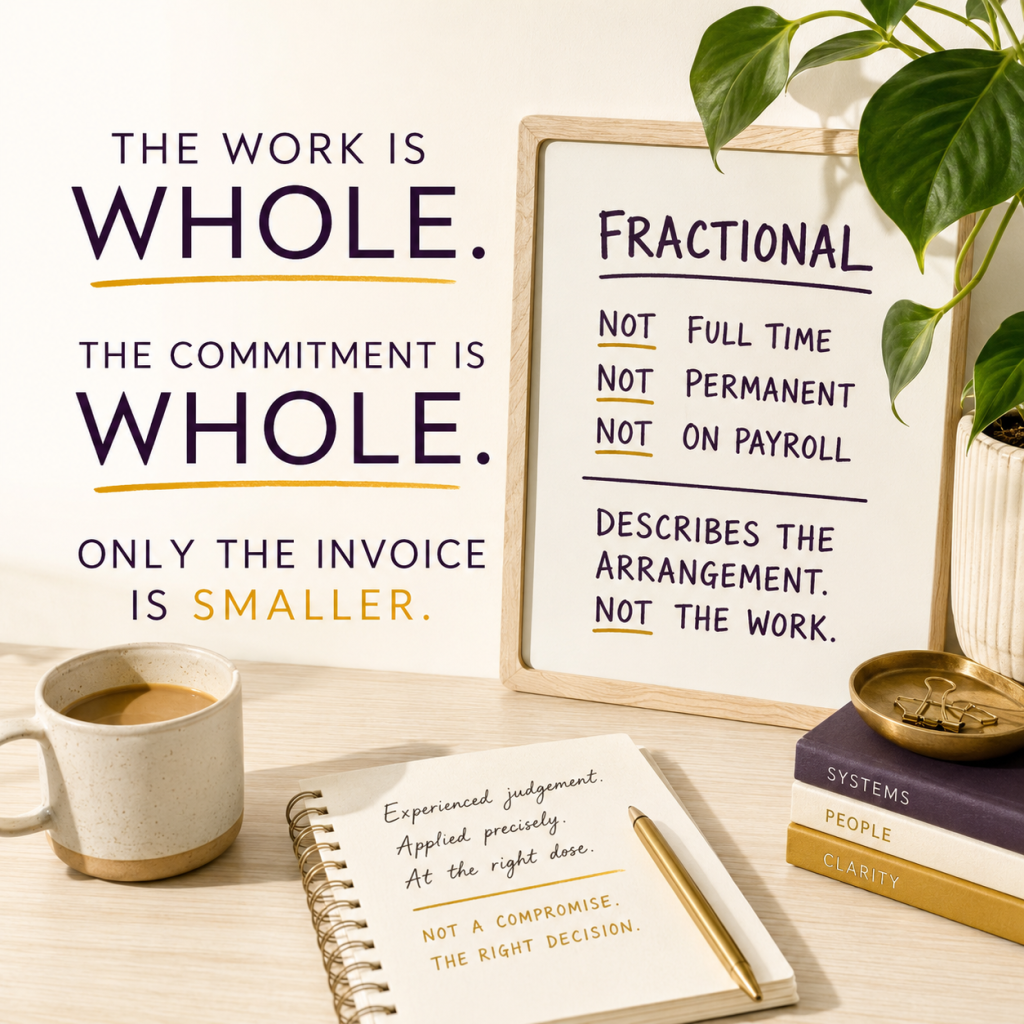
Here is the issue. The word fractional describes what the arrangement is not. It is not full time. It is not permanent. It is not a salary line on your payroll. What it fails to describe is anything about what the work actually is.
Language matters, and this particular word does quiet damage. A fraction implies the whole is what you really wanted and the piece is what you settled for. It frames senior operational support as a diluted version of the real thing, a COO with the volume turned down. That is not what happens when I work with a business, and it is not what any good operator in this space delivers.
When I step into a business, I bring the whole of my experience. Twenty years of it, across the NHS, regulated healthcare, and consultancy. All of my judgement, all of my pattern recognition, and all of my instinct for where things are quietly going wrong. None of that arrives in fractions. What is measured is my time, and time is the least interesting thing I sell.
This is where the term does its real marginalising. It centres the clock rather than the outcome. It invites clients to think in hours and day rates, to ask how many days a week they are getting, rather than to ask what will be different in their business in six months. It positions the work as a cost to be minimised rather than a capability to be gained. And it subtly signals to everyone, including the person doing the work, that this is a lesser form of the role. A stopgap. A compromise until the business can afford a proper one.
I would argue the opposite. For most small and growing businesses, bringing in senior operational leadership at the right dose is not the compromise. It is the correct decision. A full-time COO in a fifteen-person business is usually a misallocation of money and of that person's capacity. What the business actually needs is experienced judgement applied precisely, at the moments that matter, without carrying the overhead of a full executive salary. That is not a fraction of the right answer. That is the right answer.
There is also something worth naming about who this framing tends to diminish. Flexible senior work is disproportionately done by people who have deliberately built careers outside the traditional full-time executive track, often women, often carers, often people who have decided their expertise does not require a permanent desk to be valid. Calling that work fractional quietly reinforces the idea that the full-time version is the legitimate one and everything else is partial.
So what would I rather say? I do not have a perfect replacement, and I am suspicious of anyone who claims to. Operations partner comes close. Embedded operational support describes the reality of the work better than anything with COO in it. But I will be honest about the tension: fractional COO is the term people search for, and it is the term clients recognise. Refusing to use it entirely would mostly punish my own visibility rather than change the industry's vocabulary. So for now I use it as a signpost while making sure that everything behind the signpost tells the truer story.
The work is whole. The commitment is whole. Only the invoice is smaller.