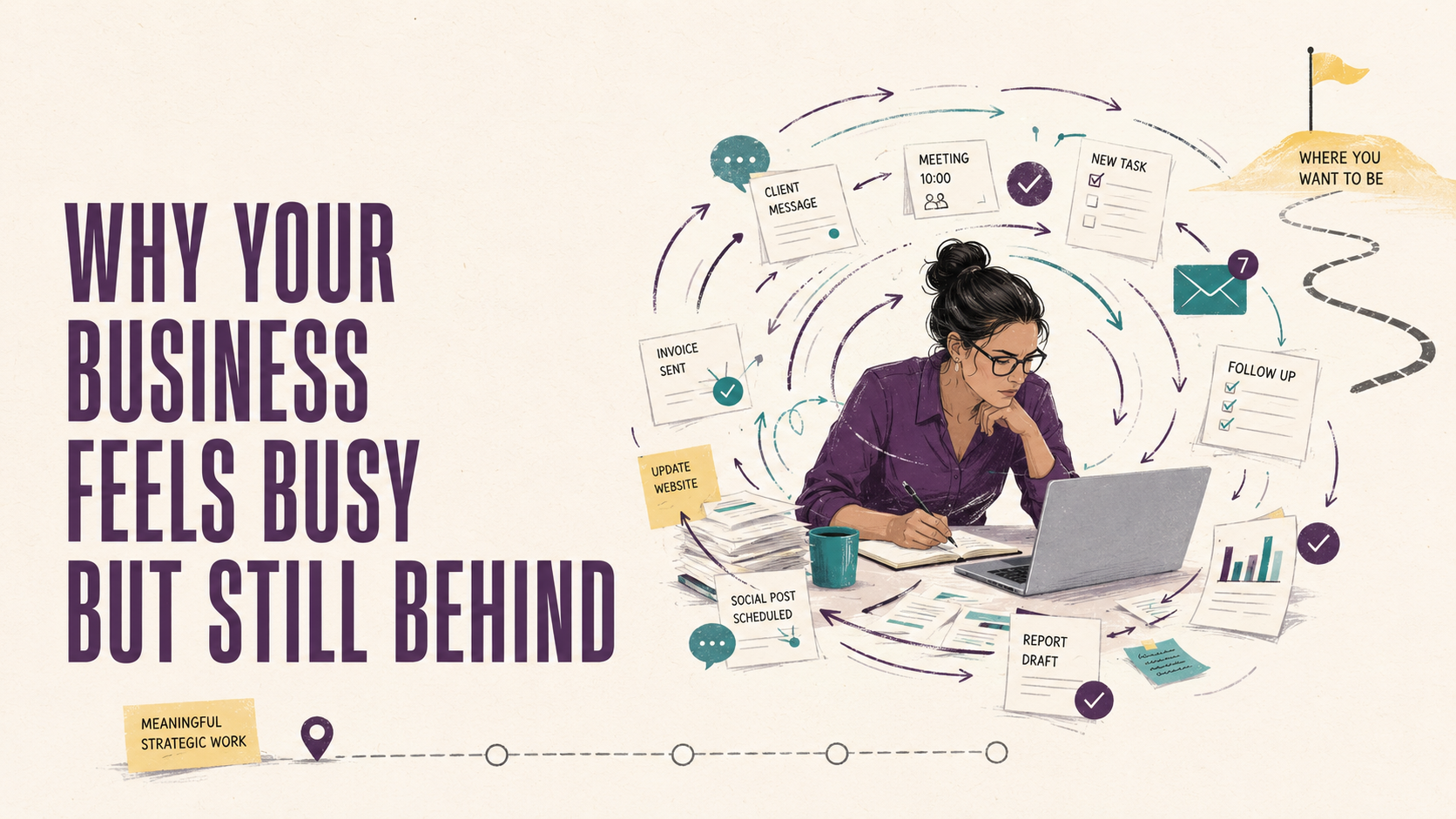
There is a particular kind of frustration that shows up in growing businesses when, on paper, everything looks active. Calendars are full, inboxes never quieten down, the team are working hard, projects are moving, customers are being served, and yet somehow, despite all of that movement, the business still feels behind.
Leaders are still chasing updates they thought had already been covered. Staff are still asking where things sit, who owns the next step, or whether something has been signed off. Meetings are being booked simply to reconnect people who should already have the same information. Strategic work keeps slipping because the day gets swallowed by solving, responding and unblocking.
Everyone is busy, but nobody feels ahead.
For many organisations this becomes so normal that they assume it is simply what growth feels like. In reality, it is often a sign that the business is carrying far more operational drag than it needs to.
When activity starts disguising inefficiency
One of the easiest traps for a business to fall into is mistaking constant activity for meaningful progress. A team can be working flat out and still spend a surprising amount of its week chasing approvals, digging through folders for the latest document, checking whether a client has replied, clarifying who was meant to do what, manually fixing reporting errors, or sitting in meetings designed purely to create alignment.
On the surface, everyone looks productive because everyone is doing something. Underneath, however, a large portion of that energy is being spent managing the gaps between systems, people and processes rather than moving the business forward.
That distinction is important, because effort does not always equal momentum. Sometimes effort is simply what businesses pour into holding together an inefficient way of working.
A business can look incredibly busy while quietly wasting hours every single day.
Why hard work is not the same as operational health
This is often where leadership teams become stuck. They can see that people are trying, they can see that workloads are heavy, and they may even be considering more hires because the pressure feels relentless, but the business still does not feel lighter.
That is usually because the issue is not a lack of effort. It is a lack of operational clarity.
When responsibilities are blurred, information lives in too many places, decisions depend on too few people, or processes only exist in verbal instruction, every task takes slightly longer than it should. Every handover carries slightly more risk. Every new project adds another layer of coordination that someone has to manually manage.
No single inefficiency feels disastrous on its own, which is why businesses tolerate them for so long. Together, however, they create the constant sense that the organisation is running hard without gaining enough ground.
The signs your business is busy, but not moving efficiently
This tends to show up in familiar ways.
The founder or leadership team still end up copied into far too much because people are nervous to move without approval. Team members ask the same questions repeatedly because there is no single source of truth. Projects pause while someone waits for information sitting in another inbox. Internal conversations become dominated by chasing, checking, reminding and reconnecting.
Customer issues may not be dramatic, but service starts to feel reactive rather than polished. Deadlines are met, but often with more last-minute pressure than should be necessary. The business is functioning, but it never quite feels in control.
These are not usually signs of a team that is not working hard enough.
They are signs of a business asking hard work to compensate for weak structure.
If your team are spending more time chasing than progressing, busy is not the problem. Friction is.
Why more people does not always fix the problem
When the pressure builds, many businesses instinctively look to headcount. Another administrator, another manager, another project lead, another pair of hands. Sometimes additional resource is absolutely needed.
But if the underlying way of working is unclear, new people often inherit the same inefficiencies as everyone else. They get copied into the same fragmented communication, they search through the same disconnected folders, they wait on the same delayed approvals, and they become part of the same reactive cycle.
This is why some organisations continue to grow in staff numbers without ever feeling more in control. The structure has not changed, only the number of people trying to navigate it.
The hidden cost of always operating in catch-up mode
Running a business that always feels behind comes with a cost beyond workload. It slows decision making because leaders are too deep in daily noise. It affects staff morale because effort stops feeling rewarding when the same avoidable issues keep resurfacing. It weakens customer experience because reactive organisations struggle to deliver the calm consistency clients notice.
Most importantly, it steals leadership capacity.
When senior people spend their days approving, checking, chasing and firefighting, they lose the headspace needed to look forward. Growth becomes something the business is surviving rather than steering.
That is where busy stops being a badge of honour and starts becoming expensive.

What operationally efficient businesses do differently
Operationally healthy businesses are not necessarily quieter, they are clearer. Work moves with less chasing. People know where information sits. Ownership is understood. Approvals are proportionate. Meetings are purposeful rather than corrective. Leaders are involved where they add value, not because every decision defaults upward.
The difference is rarely that those businesses have less to do. It is that they have built better ways of doing it.
That is what creates momentum, not simply more effort, but less wasted effort.
Busy should not be your default business model
There will always be demanding periods in any organisation. Growth brings pressure, and business is rarely static. But permanent catch-up should not be accepted as proof that everyone is working hard enough. More often, it is proof that the business is carrying more friction than it needs to.
When teams are constantly moving but the organisation still feels behind, the answer is rarely to ask people to run faster.
It is to look at what is slowing them down.
Bloomfield Street helps businesses remove operational drag
At Bloomfield Street, I help growing organisations identify where effort is being wasted, where operational bottlenecks are quietly slowing progress, and what practical changes create a business that feels lighter, clearer and easier to move forward.
Because busy is not the same as efficient, and hard work should produce momentum.