
Operations is one of those business words people use all the time, yet rarely stop to define properly.
Ask a room full of founders what ops means and you will hear everything from admin to project coordination to “just making sure things run smoothly.” It has become a catch-all phrase for the things that sit behind the scenes, but that undersells what operations actually is and why it matters so much.
Because operations is not simply organisation. It is not diary management, inbox management, or someone making sure tasks are ticked off a list. Good operations is the infrastructure that holds a business together. It is the systems, processes, controls and internal rhythm that allow growth to happen without every new client, hire or project creating another layer of noise.
When operations is working properly, most people do not notice it. The business simply feels easier to run. Information moves where it should, people know what they are responsible for, decisions happen without endless chasing, and leaders have enough visibility to focus on where the business is going rather than constantly repairing where it is wobbling.
When it is missing, businesses can still function, often for quite a long time, but they do so through effort rather than structure. Things get held together by memory, intervention, goodwill and firefighting. That may not look dramatic from the outside, but it is expensive in ways that are rarely measured.
So what does business operations actually cover?
This is where many businesses underestimate it.
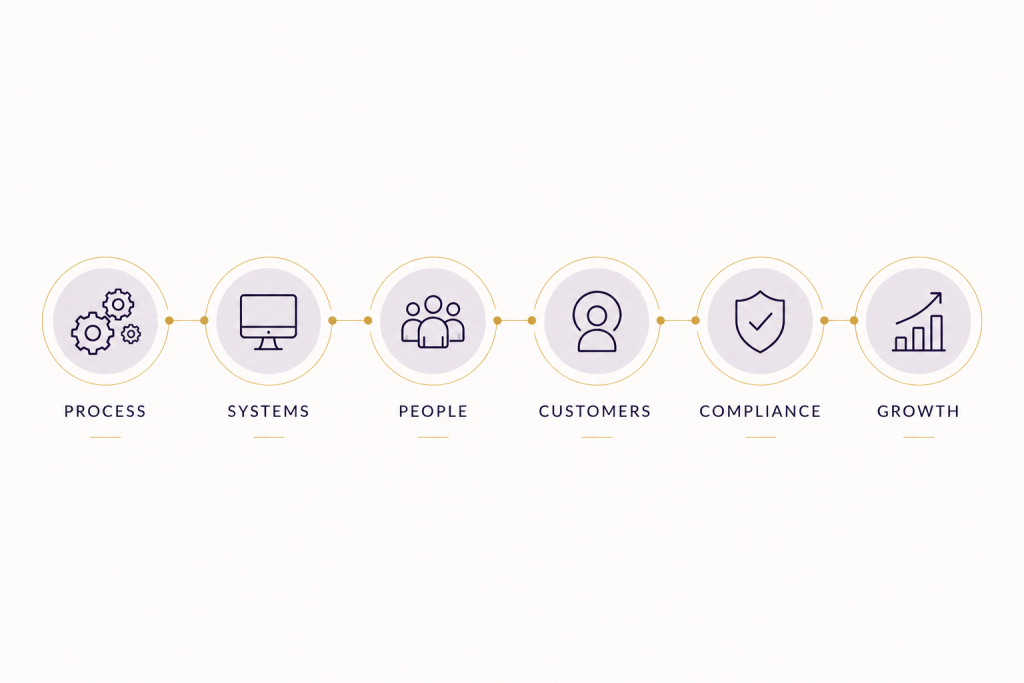
Operations is not one narrow role sitting in one corner of the company. It touches every part of how the organisation functions and, crucially, how efficiently those parts connect to each other.
It covers the practical flow of work, looking at how tasks move through the business, where delays happen, where communication gets lost, and where duplicated effort quietly drains time. It looks at whether internal systems and software are genuinely helping people work smarter or whether they have simply become another layer of administration.
It also covers team clarity, making sure responsibilities are properly owned and that the business is not dependent on one or two people carrying vital knowledge in their heads. Beyond that, operations reaches into customer journey consistency, supplier management, reporting, compliance, governance, capacity planning and business continuity.
In simple terms, operations is the framework beneath the visible service or product. Customers may not be able to point to it, but they can absolutely feel the effects of it. A smooth client experience, faster response times, fewer mistakes, more confidence in delivery, these are almost always signs of stronger operational foundations.
Operations vs delivery, and why the two are often confused
One of the most common misconceptions is that operations and delivery are the same thing. They are not.
Delivery is doing the work. It is serving the client, fulfilling the order, completing the project, providing the service.
Operations is everything that makes that delivery sustainable, consistent and commercially sensible.
A business can have a very capable delivery team and still be operationally weak. In fact, that happens all the time. Great people compensate for poor systems more often than leaders realise. They remember things manually, chase the information they need, solve avoidable issues, and plug gaps that should not exist in the first place.
From the outside, it can look like the business is coping. Internally, however, it means service quality becomes person-dependent and growth becomes heavier with every new demand.
That is why delivery alone is not enough. Businesses do not scale successfully on effort forever. At some point they need a framework.
The hidden cost of getting operations wrong
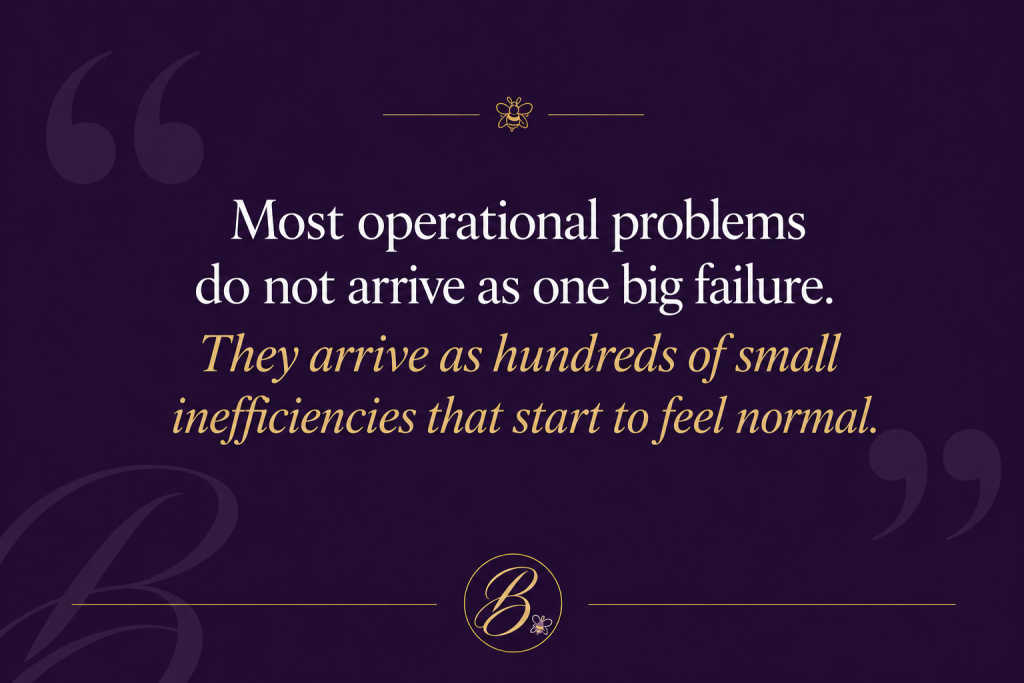
Poor operations rarely announces itself as one major collapse. It usually shows up as a hundred small inefficiencies that start to feel normal.
A founder still approving things they should not need to see. A team member spending twenty minutes finding the right version of a document. A recurring client issue because handovers are inconsistent. Projects delayed because nobody is fully clear who owns the next step. Managers manually fixing reports that should already be accurate.
None of these on their own feel catastrophic. Together, they become the background drag that makes the business feel far harder to run than it should.
This is where the cost sits, not just financially, but operationally and emotionally. Wasted salary hours, slower decisions, duplicated effort, frustrated staff, inconsistent customer experience, missed opportunities, preventable compliance gaps, and leaders who are permanently in problem-solving mode instead of growth mode.
Many organisations respond to this by assuming they need more people. More hires, another manager, another pair of hands.
Sometimes they do.
But often they do not have a people shortage, they have a structure shortage.
Adding headcount into weak systems simply means more people navigating the same confusion.
Why growing businesses tend to realise this later than they should
In the early stages of business, reactive working can feel productive. Everyone is close to the detail, the founder knows where everything sits, conversations replace documentation, and people fill gaps naturally because the team is small enough to do it.
Then growth arrives.
More clients, more staff, more suppliers, more projects, more risk, more moving parts.
Suddenly the informal way of working that once felt agile starts to feel chaotic. Things are missed, information becomes fragmented, decisions bottleneck around leadership, and every new layer of business seems to create more complexity rather than more momentum.
This is often where leaders start looking externally for the answer, usually in the form of new software, new managers or additional staff.
Those things can help, but they are not a substitute for operational clarity.
Because scaling a business without strengthening its foundations does not remove friction. It multiplies it.
What good operations actually feels like
The best sign of strong operations is not that the business becomes rigid or over-processed. It is that the business feels calmer.
People know what they own. Information is where it should be. Problems are picked up earlier. Clients receive a more consistent experience. Leaders are not the only people carrying context. Decisions move faster because there is less noise surrounding them.
Good operations does not suffocate a business, it gives it room to breathe.
And perhaps most importantly, it allows growth to feel like progress rather than pressure.
Operations is not overhead, it is protection

One of the biggest mistakes businesses make is treating operations as something to sort later, once they are bigger, busier or making more money.
In reality, operations is one of the few investments that protects profitability, team capacity, customer retention, compliance and leadership sanity all at the same time.
You do not always notice strong operations because things simply work.
You notice weak operations when every part of the business starts asking more from people than it should.
By then, the cost has usually been building for some time.
Bloomfield Street helps businesses replace chaos with clarity
At Bloomfield Street, I help growing businesses identify the operational friction that is quietly slowing them down and build practical structures that make the business easier to run, easier to scale and easier to lead.
Because chaos is not just part of growth.
More often, it is a sign the foundations need attention.