
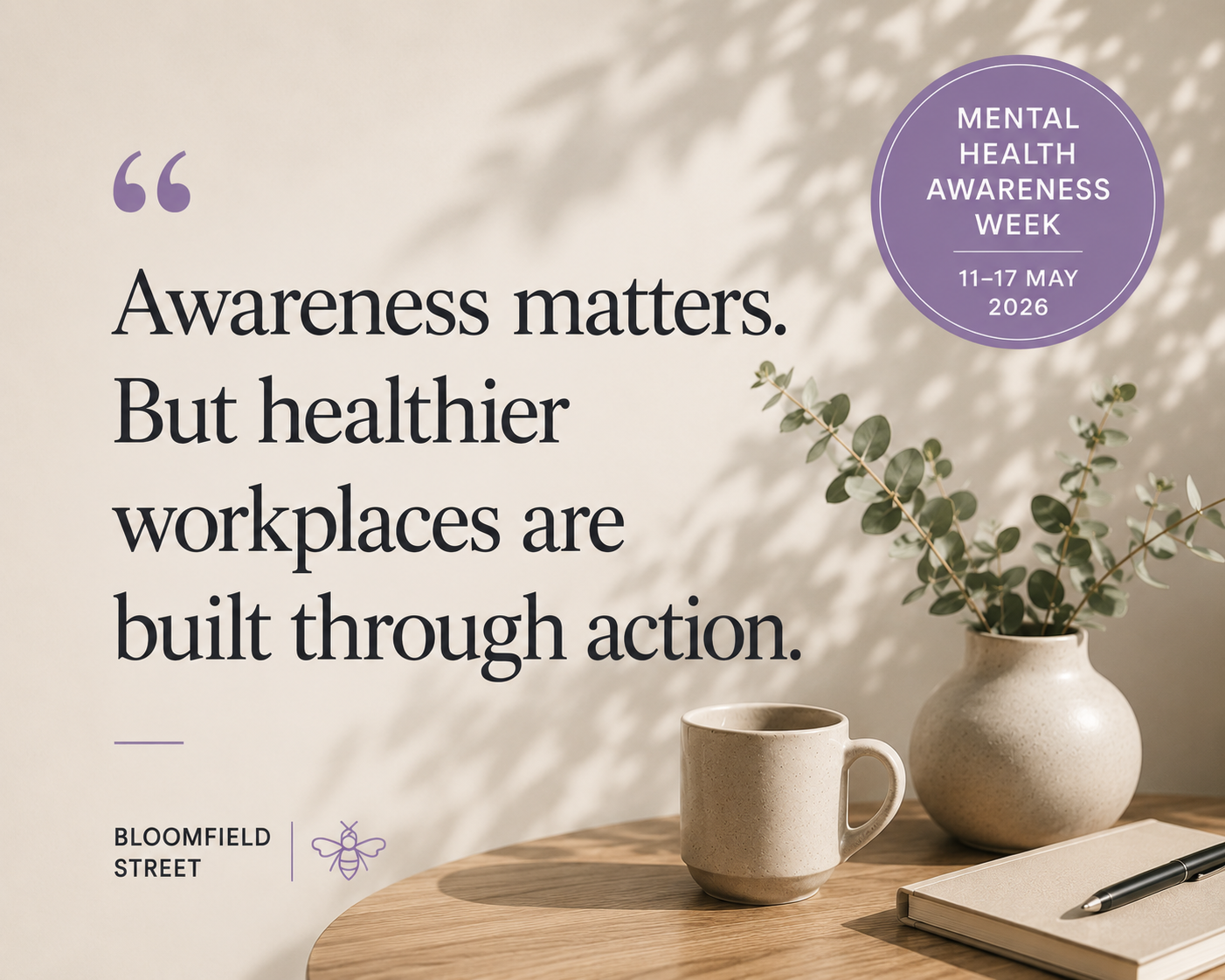
For this year’s Mental Health Awareness Week, the theme is action.
It is an interesting choice of word because conversations around workplace wellbeing have become far more visible over recent years. Organisations are more willing to discuss mental health openly, leaders are increasingly encouraged to show vulnerability, and wellbeing initiatives are now a familiar part of many workplaces.
Awareness has undoubtedly helped move the conversation forwards.
But awareness and action are not the same thing.
The more I have reflected on this year’s theme, the more I have found myself thinking about the environments people are expected to function within every day, and how often workplace wellbeing is approached as something separate from operational design rather than deeply connected to it.
Many workplace pressures are not caused by one major event. They build gradually through the cumulative effect of friction, uncertainty and sustained pressure.
Unclear expectations.
Constant urgency.
Fragmented communication.
Poorly designed processes.
Workloads that rely on reaction rather than planning.
Teams carrying responsibilities that were never realistically sustainable.
Individually, these things can seem manageable or temporary. Over time though, they shape the experience people have at work every single day.
Eventually, stress stops feeling temporary and simply becomes embedded within the culture of the organisation itself.
That is partly why I think action matters so much within this conversation. Not performative action or one-off gestures, but the quieter, more structural decisions that influence how work actually feels for the people doing it.
Because action does not always look dramatic.
Sometimes it looks like clearer ownership and accountability. Sometimes it looks like reducing unnecessary complexity or improving communication between teams. Sometimes it is ensuring workloads are realistic, creating proper documentation so knowledge is not held by one overstretched individual, or giving people enough clarity to work without operating in constant survival mode.
These operational decisions are often viewed separately from conversations about mental health, yet they directly influence the levels of pressure, uncertainty and emotional exhaustion people experience at work.
Good operational design will never eliminate every challenge somebody faces, nor should workplace wellbeing be reduced purely to systems and process. People are more complex than that. Human support, empathy, flexibility and psychological safety all matter enormously.
At the same time though, it is difficult to build healthy workplace cultures on top of operational environments that are fundamentally exhausting people.
The structure of work shapes the emotional experience of work more than many organisations realise.
People generally cope better when expectations are clear, priorities are manageable, communication is consistent and responsibilities feel achievable. They struggle more when environments become reactive, ambiguous and permanently overstretched.
None of this is particularly revolutionary. In many ways, it is simply about recognising that wellbeing is not only influenced by how organisations respond when people are struggling, but also by the conditions they create long before somebody reaches that point.
That is perhaps what I keep returning to most with this year’s Mental Health Awareness Week theme.
Awareness starts important conversations.
Action is what changes environments.